The intelligence layer for project delivery

The drawings knew.
Nobody had read them.

Resection reads every sheet, every revision, every schedule, and shows you exactly where it found what it found.

For UK subcontractors and contractors · NEC, JCT, FIDIC and bespoke

Built for NEC, JCT and FIDICEvery answer cites its sourceand declares what it hasn't read
app.resection.co.ukAsk & Search
ASK THE PROJECT● LIVE
SOURCES4021-C-210 REV B4021-C-211 REV CTQ-038
Every sheet in the set was read, or listed as not read · 1 sheet not yet read, and named.

Somebody has now.

A busy project generates hundreds of documents, letters, revisions and minutes every month. Somewhere in there is the change that needed an instruction and the condition that needed an early warning. Resection reads all of it, every week, and comes back with the short list.
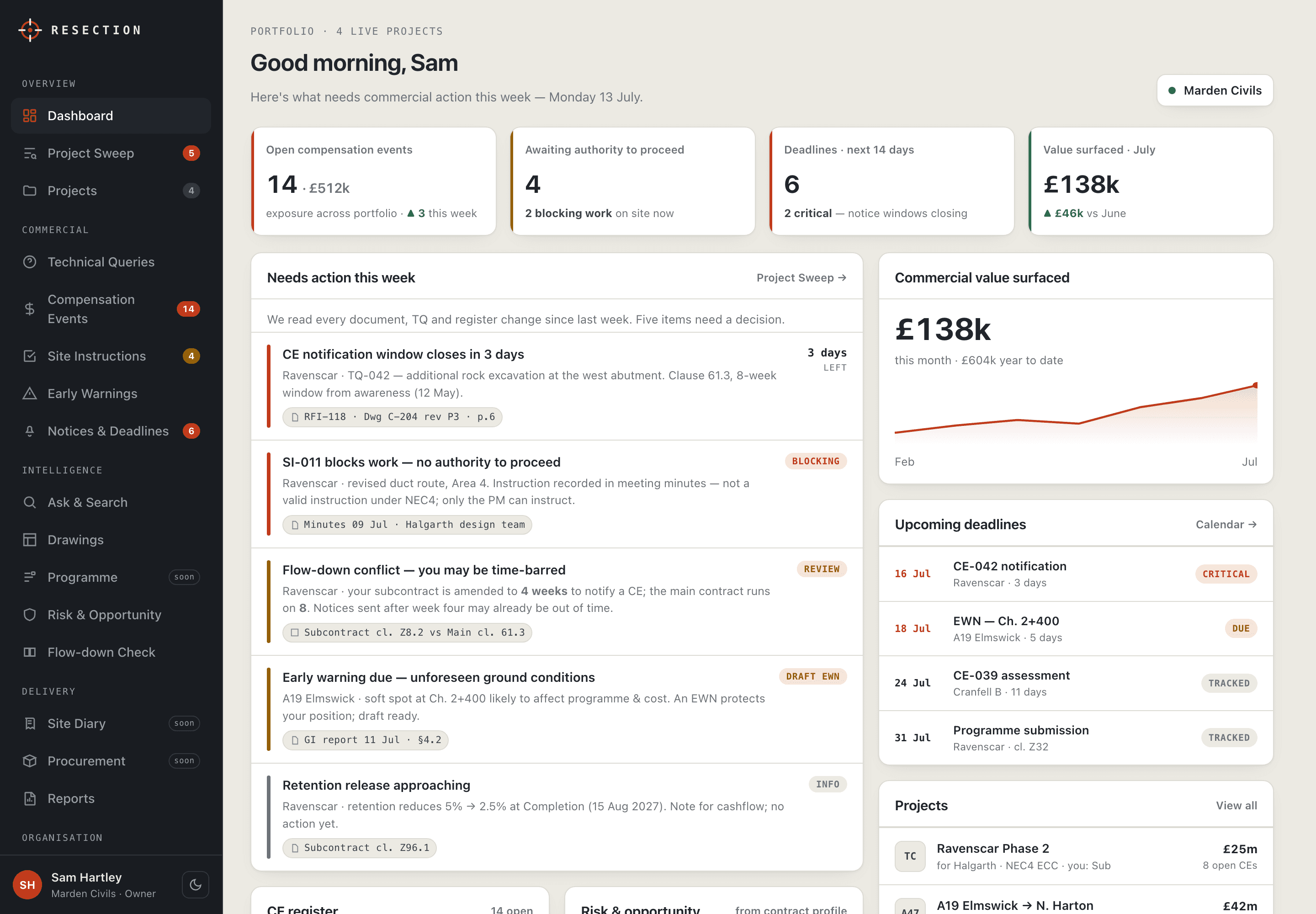
app.resection.co.ukDashboard
The Resection dashboard, marked up for review: open compensation events and their value, work awaiting authority to proceed, deadlines in the next 14 days, and commercial value surfaced this month. Two items are circled. A compensation event notification window closing in 3 days, found by the Sweep rather than entered by hand, and a flow-down conflict where the subcontract allows fewer days to notify than the main contract requires.
Found in the Sweep, not typed inYour subcontract vs the main contract

Three of those, in full

01

A compensation event notification window three days from closing. Nobody had typed it anywhere. The sweep found it in the documents.

In build
02

A subcontract amended to four weeks to notify, against a main contract running on eight. Notices sent after week four may already be out of time.

In build
03

An instruction that arrived in meeting minutes. Under NEC4 only the Project Manager can instruct, so the work it authorised had no authority behind it.

In build

Synthetic project, invented numbers and drawings. The findings are real classes, and each is marked with where it is in the build, because an example without its status is just a claim.
The guarantee

Answers you can take into the meeting.

Three things that hold whether the question is asked this afternoon or in an adjudication next year.

01

Nothing was skipped

When Resection says it found nothing, that means it checked everything and found nothing. Each sheet is either read, or listed as not read with the reason it was not. You always know the size of the set the answer came from.

02

Every answer shows its working

Not a page number. The exact wording, where it sits on the sheet, and which revision it was on, so you can check any answer against the drawing yourself. Anything that cannot show where it came from is rejected rather than stored.

03

It still holds in six months

The reading happens once into a permanent record. The answer you relied on in March is the answer you can still produce, with the same evidence attached, when it is questioned in September.

A resection, in surveying, is how you fix your position from known points. You do not estimate it, and you can show your working afterwards. That is the whole idea, applied to what your drawings say.

Built on site

Developed on live NEC and JCT contracts, from the subcontractor's side of the table.

The working methodology behind Resection comes from real delivery-stage commercial work: technical queries, early warnings, compensation events, and the registers behind them.

Built by people who run NEC contracts for a living. 25 years of tier 1 construction management experience, and every worked example on this site comes from that.

OriginA working methodology developed on live NEC4 and JCT contracts
ProvenWhole-register assessment replaced hours of contract-admin work weekly
Sharpest catchChanges needing a PM instruction, not just a designer's nod
ForSubcontractors and contractors on live projects, under NEC, JCT, FIDIC or bespoke contracts
Contracts

It works to your actual contract.

Not a generic template. Whether you are the main contractor or a subcontractor on a back-to-back deal, tell Resection the form, or upload the executed contract and its amendments. It reads the terms that matter, from notification windows to conditions precedent, and you confirm them once.

NECNEC4 and NEC3. ECC Options A to F, the Engineering and Construction Subcontract, and the Short Contract.
JCTDesign and Build, Standard Building Contract, Intermediate, Minor Works, and the matching sub-contracts.
FIDICRed, Yellow and Silver Books, 1999 and 2017 editions, for projects run to the international standard.
BespokeAmended standard forms, schedules of amendments and back-to-back subcontracts. Upload it and Resection works to your terms, not the standard defaults.

Full contract engines run on NEC4 ECC, the ECS and JCT Design & Build today. Every other form, including your amended and back-to-back subcontract, runs on the clocks, deadlines and notice periods read from your executed contract and confirmed by you once. Every assessment cites the clause it relies on.

The modules

Built for the whole commercial job. Not one clever trick.

Each part below does a specific piece of the work, and they share one growing picture of your project. It leads with what the Sweep found and what needs a decision. Every output is a cited draft you verify. You always issue the notice.

Live Documents, Ask & Search, the core TQ engineIn build Drawings, registers, notices, Sweep, reportsComing Programme, Site Diary, Procurement
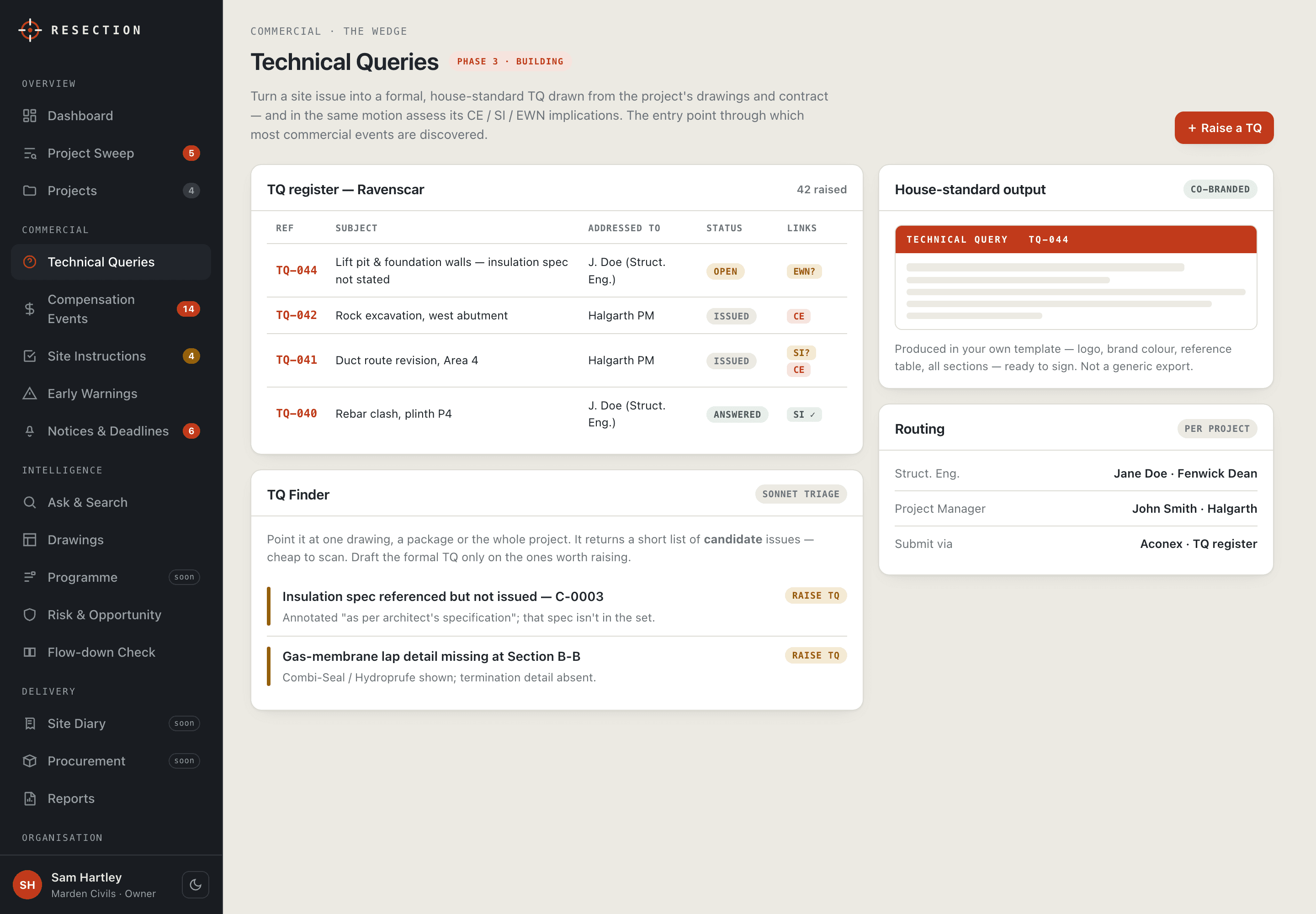
Technical Queries in Resection: a TQ register with references, subjects and status, a house-standard co-branded TQ output ready to sign, per-project routing, and TQ Finder proposing candidate issues from the drawings.
Technical queriesIn build

Technical queries, drawing-in and house-style-out

Turn a site issue into a formal technical query in your own template, ready to sign. Or point TQ Finder at a drawing, a package or the whole project and it returns a short list of candidate issues, cheap to scan, so you draft the formal query only on the ones worth raising. Each one is assessed for its CE, SI and EWN implications in the same motion.

  • Your house style: logo, brand colour, reference table, every section.
  • Live today: the register, editing, routing and branded output. TQ Finder and coupled assessment are in build.
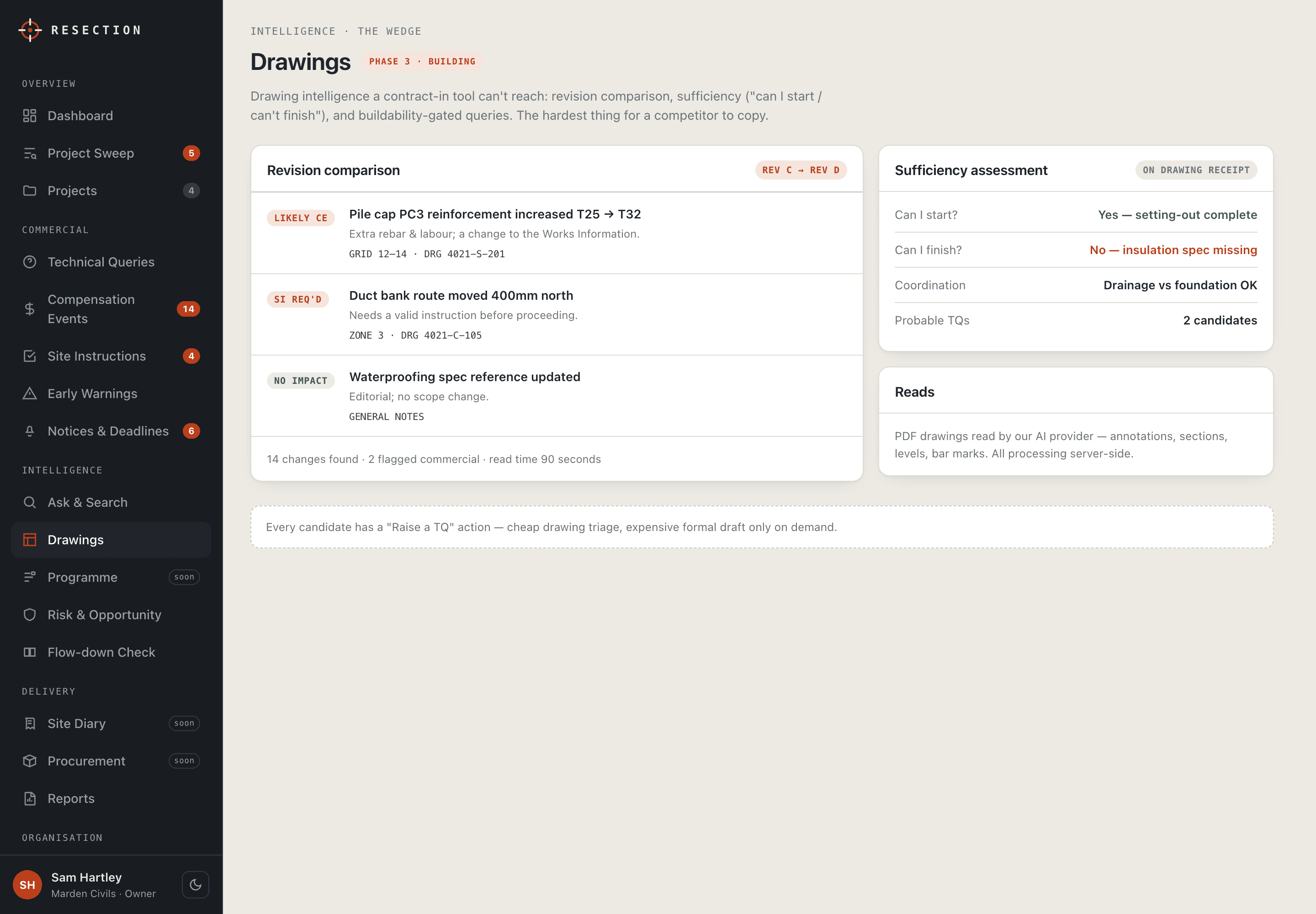
Drawing intelligence in Resection: a Rev C to Rev D revision comparison classifying each change as likely CE, instruction required or no impact, alongside a sufficiency assessment answering can I start and can I finish.
Drawing intelligenceIn build

Reads the drawings themselves

Revisions, annotations, markups and section marks, read from the PDF itself. Compare Rev C to Rev D and see what changed, and whether it is a compensation event or needs an instruction before you proceed. Sufficiency checks tell you what you can start and what you can't finish.

  • Every change classified: likely CE, instruction required, or no impact.
  • Every candidate carries a one-click "raise a TQ".
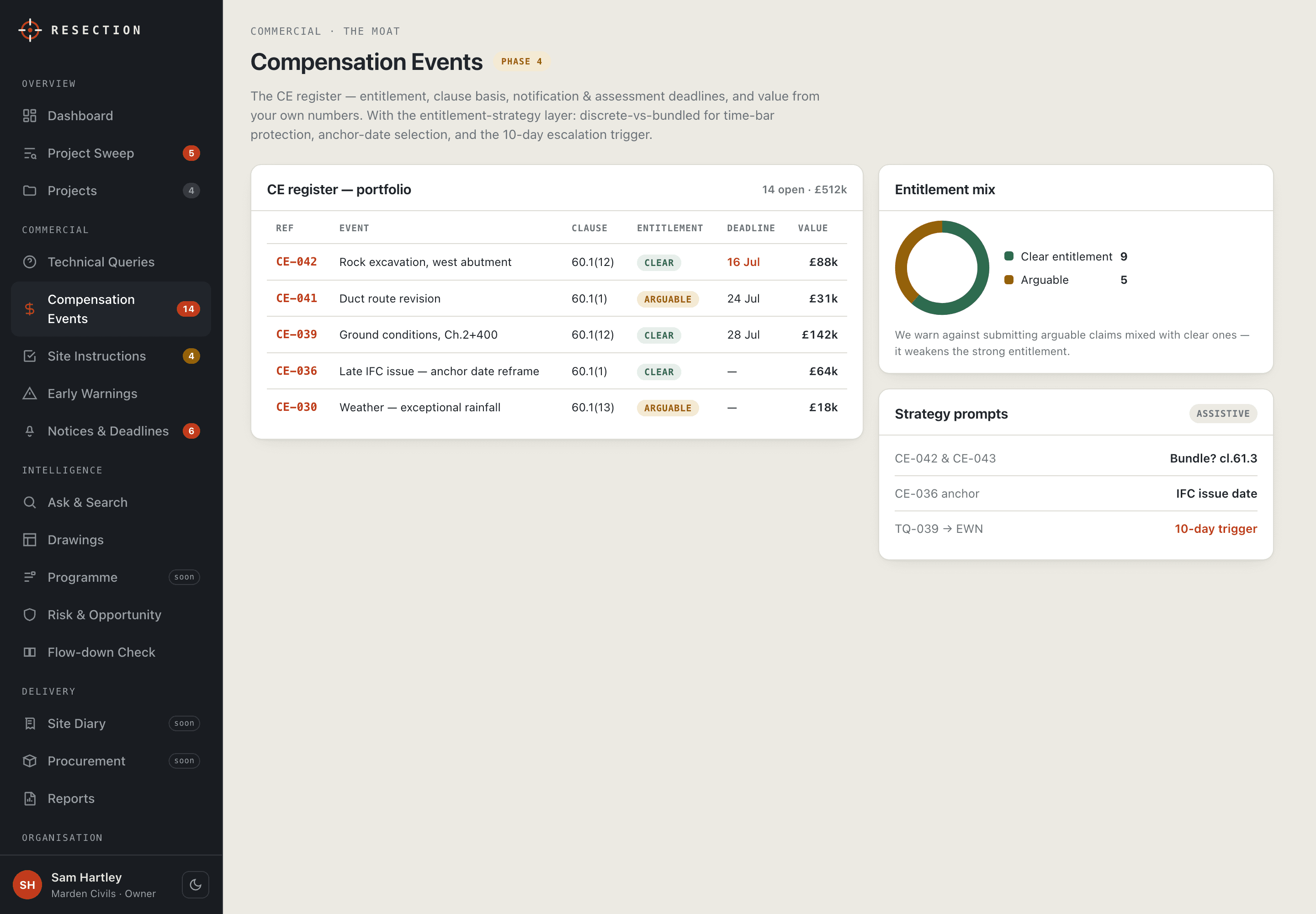
The compensation-event register in Resection: each event with clause basis, entitlement marked clear or arguable, deadline and value, an entitlement-mix chart, and assistive strategy prompts for bundling, anchor dates and 10-day escalation.
Commercial registersIn build

The commercial registers, and the strategy behind them

Every compensation event, site instruction and early warning with its entitlement, clause basis, deadline and value from your own numbers. The strategy layer works the detail a busy team misses: whether to keep events discrete or bundle them for the time-bar, which anchor date to run from, and a 10-day trigger to escalate an open query to an early warning.

  • Flags clear entitlement against arguable, and warns against mixing them.
  • The SI register surfaces authority to proceed: can you lawfully build it yet.
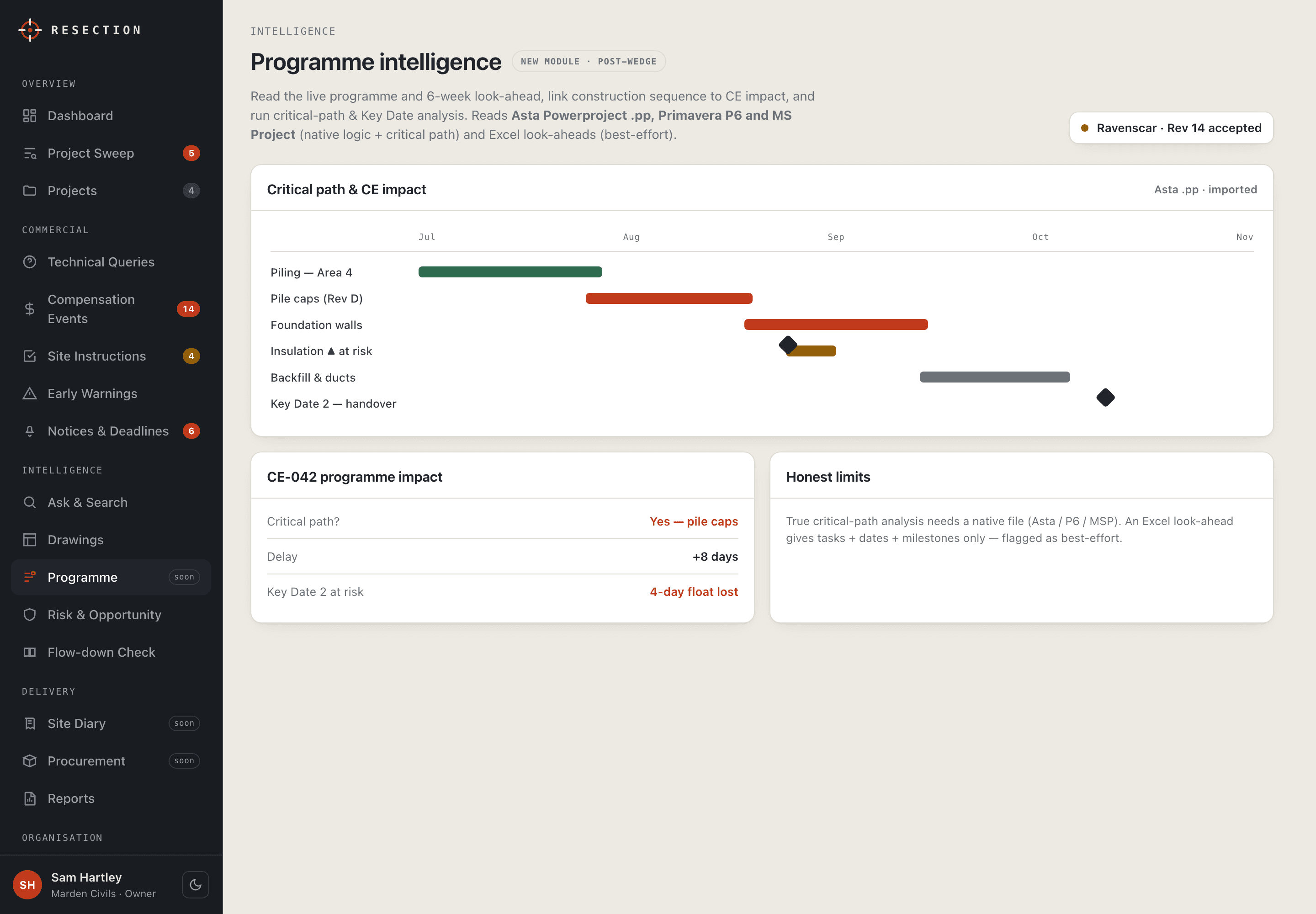
Programme intelligence in Resection: a Gantt reading a native Asta Powerproject file, linking the construction sequence to compensation-event impact and Key Dates, with an honest note that Excel look-aheads are best-effort.
On the roadmapComing

Programme intelligence

Reads Asta Powerproject, Primavera P6 and MS Project, links the construction sequence to compensation-event impact, and runs critical-path and Key Date analysis. It is honest about its limits: true critical-path needs a native file, and an Excel look-ahead gives tasks and dates only, flagged best-effort.

Notices & deadlinesIn build

Nothing time-bars

A live compliance calendar tracking every notice window and key date.

Flow-down checkIn build

For subcontractors

Catch the mismatched notice period that would time-bar you against the main contract, before it does.

ReportsIn build

Board-ready, your template

Weekly and monthly reports in a controlled-disclosure tone, drafted to issue standard.

Ask & searchLive

Cited answers, on tap

Plain-English answers from your own documents, every one cited. A supporting tool, not the headline.

Project Sweep

Your week starts with what needs a decision.

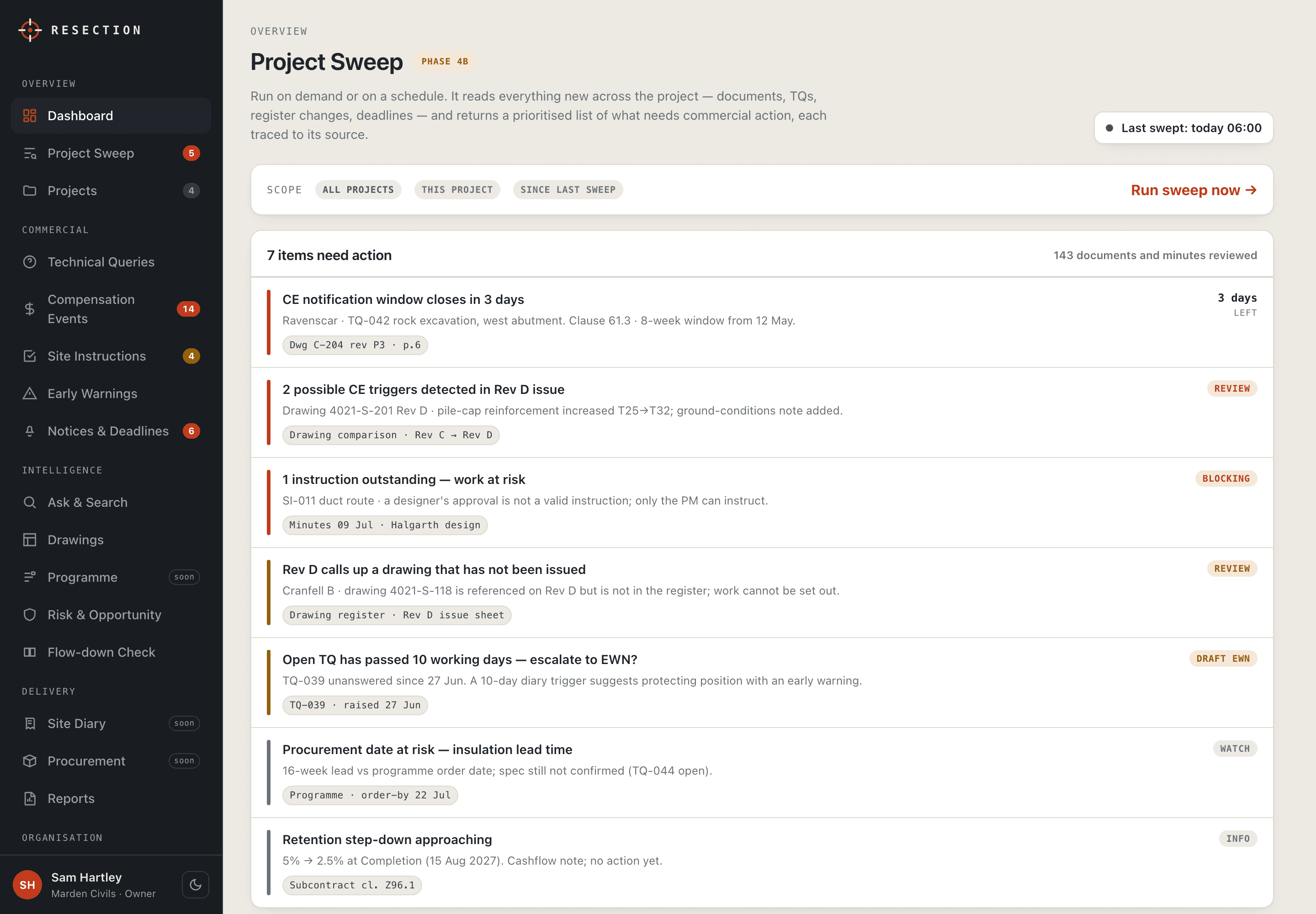
Run it on demand or on a schedule. Resection reads everything new across the project: documents, TQs, register changes and deadlines. It returns a prioritised list of what needs commercial action, each item traced back to its source.

app.resection.co.ukProject Sweep
The Project Sweep in Resection: seven items need action from 143 documents and minutes reviewed. A CE notification window closing in 3 days, possible CE triggers detected in a Rev D issue, an instruction outstanding that is blocking work, a Rev D that calls up a drawing not yet issued, an open TQ passing 10 working days ready to escalate to an early warning, a procurement date at risk on lead time, and a retention step-down approaching.
Start of week

The Sweep lands

Everything the project produced, read for you. The handful of things that need a decision, in priority order.

Daily

Ask your project anything

Plain-English answers from your own documents, with the source cited every time.

As they arise

TQs & commercial events

Raise the query, assess the CE, request the instruction. One motion, straight to the register.

When drawings land

Revision comparison

Rev C to Rev D in ninety seconds. Every change found. The commercial ones flagged.

End of week

The report writes itself

The week's registers, activity and your notes, drafted to issue standard. Add your voice. Send. Go home.

Flow-down check

Catch the mismatched notice period before it time-bars you.

Your notice period and the contractor's are set to interlock, and an amendment to either one breaks the interlock without saying so. The gap is invisible until the day you need it. Resection reads both documents and puts the two periods side by side, clause against clause.

Worked exampleCompensation event, notice period
Your subcontract saysNotify the contractor within 7 weeks of becoming aware (NEC4 ECS).
The main contract saysThe contractor notifies the Project Manager within 8 weeks (NEC4 ECC).
What that meansOne week is all the contractor has to pass it up. Amend either period and the flow-down stops working.
Standard unamended periods, shown to make the mechanism legible. Resection reads the actual clauses from your executed documents, amendments included, and shows you both with the reference attached.

Both documents, one comparison

Upload the subcontract and the main contract terms you are bound to. Notice periods, conditions precedent and time-bars are read from each and lined up against each other.

The gap, in days

Where your obligation runs shorter than the one above you, the difference is stated plainly, with the clause reference from both documents so you can check it.

Before it matters, not after

The check runs when the documents go in, so the shorter clock is a known number from week one rather than a discovery on the day you try to notify.

Where it fits

Works alongside your existing systems. Not instead of them.

Whatever you run for contract admin, keep running it. Resection reads what the project produces and hands findings over properly assessed and properly drafted, ready to file where you file everything else. Nothing to migrate. Nothing to rip out.

Works with what you have

Resection reads the drawings, TQs, letters and site diaries your project is already producing. Your admin system carries on doing its job unchanged.

Hands off cleanly

Assessed events export in a ready-to-file format with the clause basis and supporting narrative attached.

Lightweight by design

No implementation project, no procurement marathon. Your team is working in it the first week.

The Journal

Measured thinking on AI in construction project management.

All essays →

Long-form essays, practitioner-written. Free.
Long-form, practitioner-written, no news aggregation. Read by PMs, commercial managers and directors across UK construction.

Security & data

Uploading a contract has to be safe.

You will be putting contracts, drawings and live commercial positions into Resection. That data has to be protected, and you have to be able to prove it to your client and your IT team. Security is built in from the first line of code, and we put our security overview in front of your IT team before you commit.

✓ UK / EU storage

Stored in the UK and EU. Processed with disclosed subprocessors.

Your documents and data are stored entirely in UK and EU regions and never stored outside them. AI analysis is performed by our AI provider as a disclosed US subprocessor: in memory, for processing only, never stored abroad, never used for training. The full data-flow map is in the security overview your IT team gets before you commit.

✓ Never trained on

Your documents don't train AI

Your content produces your result and is never used to train any AI model. That is a contractual commitment with our AI provider, not a setting. Inline processing is retained by our AI provider for up to 30 days for abuse monitoring, then deleted. Nothing is retained for training, contractually. A zero-retention agreement is on our roadmap.

✓ Isolated

Walled off, company by company

Your data is yours alone. Every company is separated at the database level, enforced by the database itself rather than by application code, so there is no shared visibility, ever. An independent security review is on the roadmap before any pilot data goes in.

✓ Audited

Full audit trail

Nothing is ever silently changed. Every action is recorded, and records can be added but never edited or removed, so the history stands up as evidence in a dispute.

✓ Yours to delete

You control your data

You set retention. Delete a document, or your whole account, and it is gone.

✓ Certified

Certification you can check

Cyber Essentials and ISO 27001 are both on the roadmap, not held today. A written security overview for your IT team on request.

Questions

The questions we get asked first.

Mostly by people who have already tried doing this another way, which is the right instinct. Straight answers, including where the answer is no.

You can, and for a quick question across a few sheets it works well. We use those tools daily.

The difference shows up when the answer has to hold. A chat tool retrieves the parts of your drawings that look relevant to the question and answers from those, which is the right design for a conversation. It means the answer is drawn from a sample, and you cannot see how big that sample was. Resection reads for a different purpose: it accounts for every sheet, cites the exact text behind every fact, and stores the reading so the same question returns the same answer months later.

Curiosity and evidence are different jobs. If you are going to stake a notice on it, you need the second one.

It means the set is closed. Every sheet you upload is either read, or listed as not read with the reason, and that list is derived from the data rather than maintained by hand.

So when an answer says nothing was found, you can tell the difference between “nothing is there” and “nothing was in the part I looked at”. Every answer carries that boundary with it.

Follow the citation. Every fact carries the wording it came from, where that wording sits on the sheet, and the revision it was on, so you can put the drawing next to the answer and confirm it in seconds.

That is also the internal test: anything the system cannot tie back to specific source text is rejected rather than stored. You should never have to take an answer on trust, because a claim you cannot check is not worth having in a commercial argument.

Yes. The reading is done once and kept, and later questions run against that stored record rather than re-reading from scratch.

This matters most at the point it is challenged. An assessment you made in the spring can be produced again in the autumn, with the same citations, rather than being re-derived and coming out slightly differently.

No, and it never will. Resection checks consistency and coordination: whether two documents say the same thing, whether a reference points at something that exists, whether a revision changed something that affects you.

Whether the design is adequate is engineering judgement, and that stays with your engineer. We are careful about this line because a tool that blurred it would be dangerous.

It says so, in the answer, rather than filling the gap with something plausible.

Scanned sheets, hand mark-ups and drawn detail with no written label are all real. Where something has not been read it appears on the list of what was not covered, instead of quietly shrinking the set the answer came from.

Pilot programme

A handful of teams. Full deployment. Founder-level support.

Founding pilots get preferential pricing locked in for the term, and direct influence over what gets built next. Both of those are only possible while the group is small, which is why it is small. Tell us about your project and we will say honestly whether it is a fit.

No mailing list games. One reply, from the founder.

Not ready for that? The journal goes out to people doing this work: practitioner-written, no news, and one click unsubscribes you.